Equipped with a CNAS-accredited laboratory and staffed by professionally certified inspection personnel, we offer comprehensive physical and chemical testing as well as welding qualification services. With rigorous quality control over the welding integrity and physicochemical properties of prefabricated pipes, we ensure full compliance with industry-specific standards, providing a solid safety foundation for your engineering projects.
Corrosion poses a persistent and critical challenge in oil and gas production and transportation. Harmful media such as CO₂, H₂S, seawater, and chlorides in crude oil and natural gas continuously degrade pipeline integrity, weaken structural strength, and threaten operational safety. Jiangsu Zhongxin Pipe Sci-Tech Co., Ltd. (Zonpipe) delivers high-performance CRA solutions to safeguard your pipeline infrastructure, minimize costly repairs, reduce downtime, and prevent economic losses.
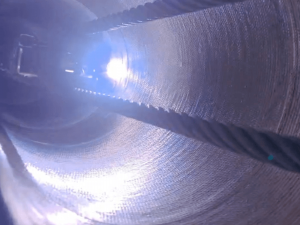
The weld overlay clad steel pipe adopts advanced automatic weld overlay technology to clad a layer of high-wear-resistant, corrosion-resistant and high-temperature-resistant alloy materials (such as nickel-based alloy 825, 625, duplex stainless steel, etc.) on the inner wall of the base pipe. By accurately controlling the cladding thickness and dilution rate, it achieves perfect integration of the base pipe and the surfacing layer, significantly improving the service life and safety performance of the pipe under extreme working conditions. The product is accurately adapted to designated high-end industries and widely used in heavy industrial fields such as oil and gas (offshore oil and gas platforms, downhole oil and gas transmission pipelines), chemical industry (supporting pipelines for high-end chemical reactors, transportation of corrosive media), marine engineering (seawater desalination, offshore platform pipe networks), and electric power (nuclear power plant cooling systems, high-temperature and high-pressure pipelines in power plants). It is the core solution to replace traditional lined pipes and integral alloy pipes.
In thermal power, nuclear power, new energy (offshore wind, photovoltaic energy storage) and UHV power facilities, pipeline systems face severe corrosion. Acidic slurry (SO₂, NOₓ) in FGD systems, high-temperature/high-pressure steam and seawater/freshwater corrosion in nuclear islands, salt spray in offshore wind, and corrosive media in UHV converter stations cause pitting, stress corrosion cracking and rust in traditional pipelines. Single-material pipelines (carbon steel, pure alloy) either lack corrosion resistance, have short service life and frequent maintenance, or are costly, endangering operation safety and increasing costs.
The pharmaceutical and food & beverage industries have extremely high requirements for fluid conveyance pipelines. Traditional pipes face multiple pain points in practical applications:
Health and Safety Risks Traditional carbon steel pipes are prone to rust and scaling, which can contaminate media such as liquid medicines, purified water, and beverage stock solutions, affecting product purity and food safety; welds of some stainless steel pipes are prone to intergranular corrosion, breeding microorganisms and causing batch contamination.
 Zonpipe